
Developer productivity has evolved significantly over the past decade. What once depended primarily on programming skill and experience now increasingly depends on workflow design and tool optimization. As codebases grow larger and delivery cycles shorten, engineers are expected to build faster without sacrificing quality. In this context, GitHub Copilot has emerged as one of the most influential tools reshaping modern software development.
GitHub Copilot is not simply an advanced autocomplete engine. It represents a fundamental shift in how developers interact with code. By integrating artificial intelligence directly into the coding environment, Copilot reduces repetitive tasks, accelerates implementation, and minimizes cognitive friction. When used strategically, it enhances developer productivity in measurable and sustainable ways.
The Productivity Problem in Modern Software Development
To understand Copilot’s impact, it is important to first recognize the challenges developers face today. Software engineering involves far more than writing logic. Engineers continuously switch between writing code, reading documentation, reviewing pull requests, fixing bugs, attending meetings, and responding to communication tools. This constant context switching disrupts focus and drains cognitive energy.
Additionally, much of development time is spent on repetitive or predictable tasks. Writing boilerplate structures, configuring API endpoints, setting up models, handling validation, and creating unit tests can consume a substantial portion of a developer’s schedule. While these tasks are necessary, they rarely require deep creative thinking. Yet they consume the same mental bandwidth as complex architectural work.
GitHub Copilot directly addresses this imbalance by automating the predictable parts of development, allowing engineers to focus on higher-level reasoning and problem-solving.
How GitHub Copilot Works in Practice
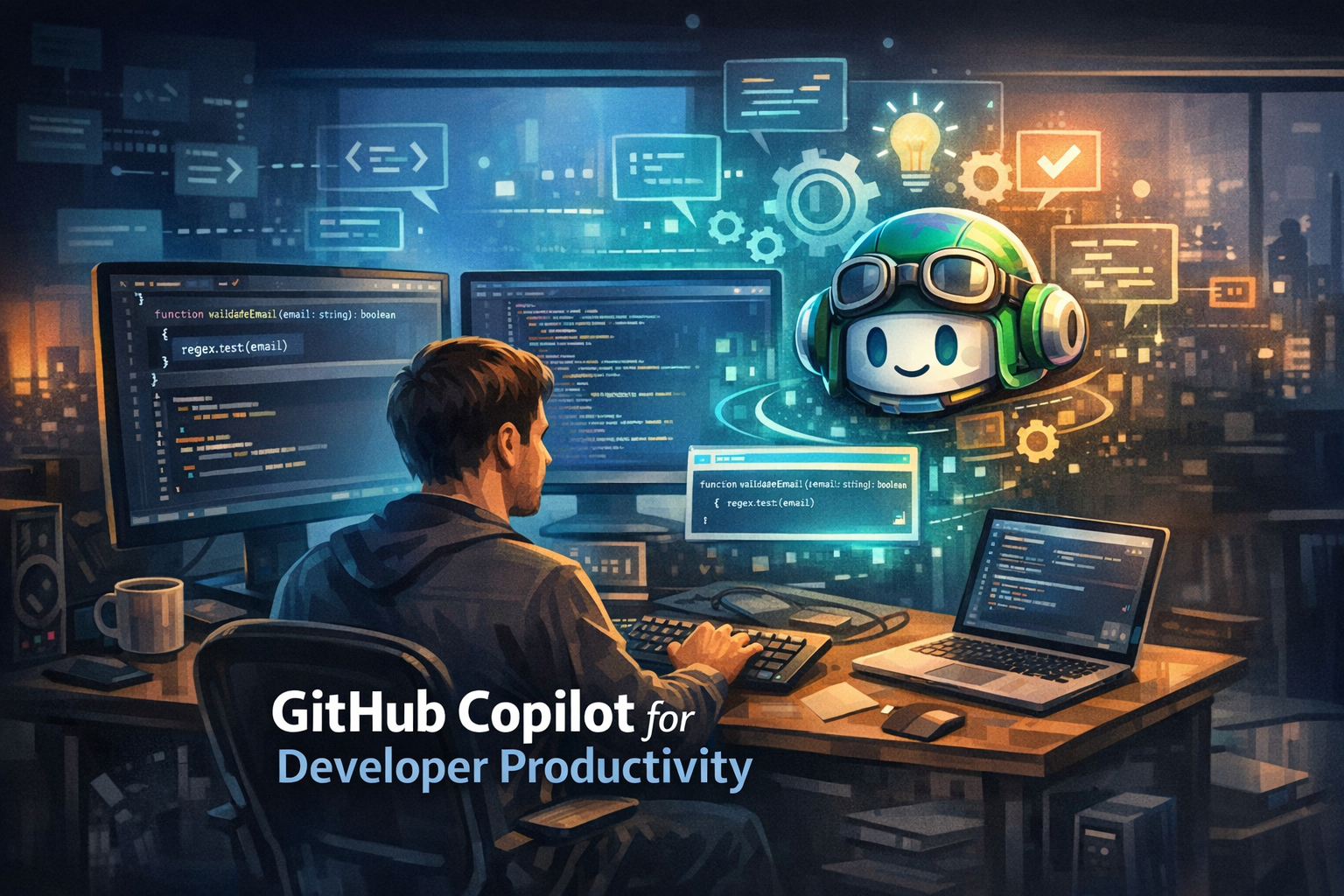
GitHub Copilot integrates into popular development environments such as Visual Studio Code and JetBrains IDEs. As developers write code, Copilot analyzes the surrounding context, including function names, comments, variable patterns, and file structure. It then generates real-time suggestions that range from completing a single line to drafting entire functions.
The key distinction between Copilot and traditional autocomplete tools lies in contextual understanding. Instead of merely suggesting previously defined variables or methods, Copilot predicts intent. For example, when a developer writes a descriptive comment like “create middleware to validate JWT token,” Copilot can propose a full implementation that aligns with common authentication patterns.
This predictive capability dramatically reduces the need to leave the development environment in search of examples. Fewer browser tabs mean fewer interruptions. Fewer interruptions mean longer periods of sustained focus. Sustained focus is directly linked to higher developer productivity.
Reducing Cognitive Load Through AI Assistance
One of the most underestimated productivity factors in software engineering is cognitive load. Developers constantly juggle syntax rules, framework conventions, architectural patterns, and business requirements. Even experienced engineers experience mental fatigue from repeatedly recalling standard implementations.
GitHub Copilot acts as an external memory system. Instead of recalling exact syntax for a configuration or library method, developers can describe what they intend to build and refine the generated suggestion. This shift from recall to review significantly lowers mental strain.
Lower cognitive load has compounding benefits. Developers make fewer small mistakes. They maintain concentration for longer periods. They experience less frustration during repetitive tasks. Over weeks and months, these small improvements translate into meaningful efficiency gains.
Accelerating Feature Development
Speed is often misunderstood in engineering. True speed is not typing faster; it is reducing friction. GitHub Copilot accelerates feature development by eliminating time spent writing repetitive scaffolding.
Consider a backend engineer building an API endpoint. The process typically involves defining routes, handling validation, structuring responses, managing error handling, and writing associated tests. Much of this structure follows predictable patterns. Copilot can generate the foundational layer within seconds, allowing the engineer to focus on business logic and edge cases.
This does not eliminate the need for human oversight. Instead, it shifts the developer’s role from code generator to code reviewer and optimizer. The result is faster iteration cycles without sacrificing quality.
Improving Test Coverage and Code Reliability
Testing is an area where many teams struggle to maintain discipline due to time constraints. Writing comprehensive test cases can feel repetitive, particularly when covering multiple edge conditions. GitHub Copilot assists by drafting unit tests based on existing function definitions.
By analyzing function logic, Copilot can suggest typical input scenarios, expected outputs, and even mocking strategies. Developers can then refine these drafts to align with project standards. This significantly reduces the barrier to writing tests.
Improved test coverage has a direct impact on long-term productivity. When engineers trust their test suite, they refactor more confidently. Confident refactoring leads to cleaner architecture. Cleaner architecture reduces technical debt. Reduced technical debt accelerates future development cycles.
Enhancing Flow State and Deep Work
Flow state is a condition of deep concentration where developers produce their best work. Achieving flow requires uninterrupted time and minimal distractions. Traditional development often disrupts flow due to frequent documentation searches or syntax checks.
GitHub Copilot minimizes these interruptions by providing contextual suggestions within the editor. Instead of leaving the coding environment to look up common implementations, developers can remain immersed in their task. The continuity preserves mental momentum.
Maintaining flow is one of the most powerful developer productivity advantages. Engineers who remain in deep work for extended periods complete complex features more efficiently and produce higher-quality code.
Supporting Learning and Skill Development
Some critics argue that AI coding tools may weaken foundational skills. However, when used intentionally, GitHub Copilot can enhance learning. By observing generated patterns, developers gain exposure to idiomatic structures and best practices.
For engineers exploring a new framework, Copilot can demonstrate how common components are structured. Rather than copying examples from external sources, developers learn within their own codebase context. This contextual learning accelerates onboarding and reduces ramp-up time for new technologies.
Junior developers, in particular, can benefit from guided suggestions that illustrate proper structure and syntax. When paired with strong code review practices, Copilot becomes an educational accelerator rather than a shortcut.
The Importance of Responsible Usage
While GitHub Copilot improves developer productivity, responsible usage is critical. AI-generated code should never be accepted blindly. Developers must review suggestions carefully, ensure alignment with architectural standards, and validate security implications.
Copilot excels at drafting common patterns, but it does not understand business context the way humans do. Security-sensitive logic, authentication flows, and performance-critical algorithms require deliberate human oversight.
The most productive teams treat Copilot as a collaborator rather than an authority. It drafts; engineers refine. It suggests; engineers decide. This balanced relationship preserves code quality while maximizing efficiency.
Measuring Productivity Gains
Organizations adopting GitHub Copilot often measure its impact through cycle time reduction, improved pull request throughput, and enhanced developer satisfaction. Rather than focusing on superficial metrics such as lines of code written, effective teams evaluate outcomes.
Faster feature completion, shorter review cycles, and reduced bug frequency are meaningful indicators of productivity improvement. Additionally, qualitative feedback from developers often reveals reduced frustration and smoother workflows.
Over time, the compounding effect of small time savings becomes substantial. Saving even thirty minutes per day per engineer results in significant annual gains across a team.
Copilot in Enterprise Environments
In enterprise settings, concerns around security, compliance, and governance must be addressed before adopting AI-assisted development tools. GitHub provides enterprise configurations that allow organizations to manage privacy settings and control code suggestions.
With appropriate governance, Copilot can integrate seamlessly into large-scale development operations. In fact, enterprise teams often experience amplified benefits due to the scale of repetitive tasks across large codebases.
Standardized patterns within enterprise repositories further improve suggestion accuracy, making Copilot more effective over time.
The Future of AI in Software Development
GitHub Copilot represents the early stage of a broader transformation in software engineering. AI-assisted development tools are increasingly capable of understanding architectural context, generating documentation, and assisting in debugging.
As these tools mature, the role of the developer will continue to shift toward system design, critical thinking, and decision-making. Repetitive implementation work will gradually become more automated. Engineers who adapt to this shift will experience greater productivity and competitive advantage.
Rather than replacing developers, AI augments their capabilities. The combination of human reasoning and machine-generated assistance creates a powerful productivity multiplier.
Conclusion: GitHub Copilot as a Workflow Multiplier
GitHub Copilot significantly enhances developer productivity by reducing cognitive load, accelerating repetitive tasks, improving test generation, and preserving deep focus. Its value lies not in replacing human expertise but in eliminating friction from daily workflows.
When used strategically, Copilot transforms coding from a syntax-heavy task into a higher-level design activity. Developers spend less time recalling patterns and more time solving meaningful problems. Over time, this shift leads to faster delivery cycles, cleaner codebases, and more sustainable engineering practices.
In a competitive software landscape where efficiency and quality determine success, GitHub Copilot stands out as a practical and impactful productivity tool. For teams seeking smarter workflows and measurable performance gains, integrating AI-assisted development is no longer optional—it is a strategic advantage.