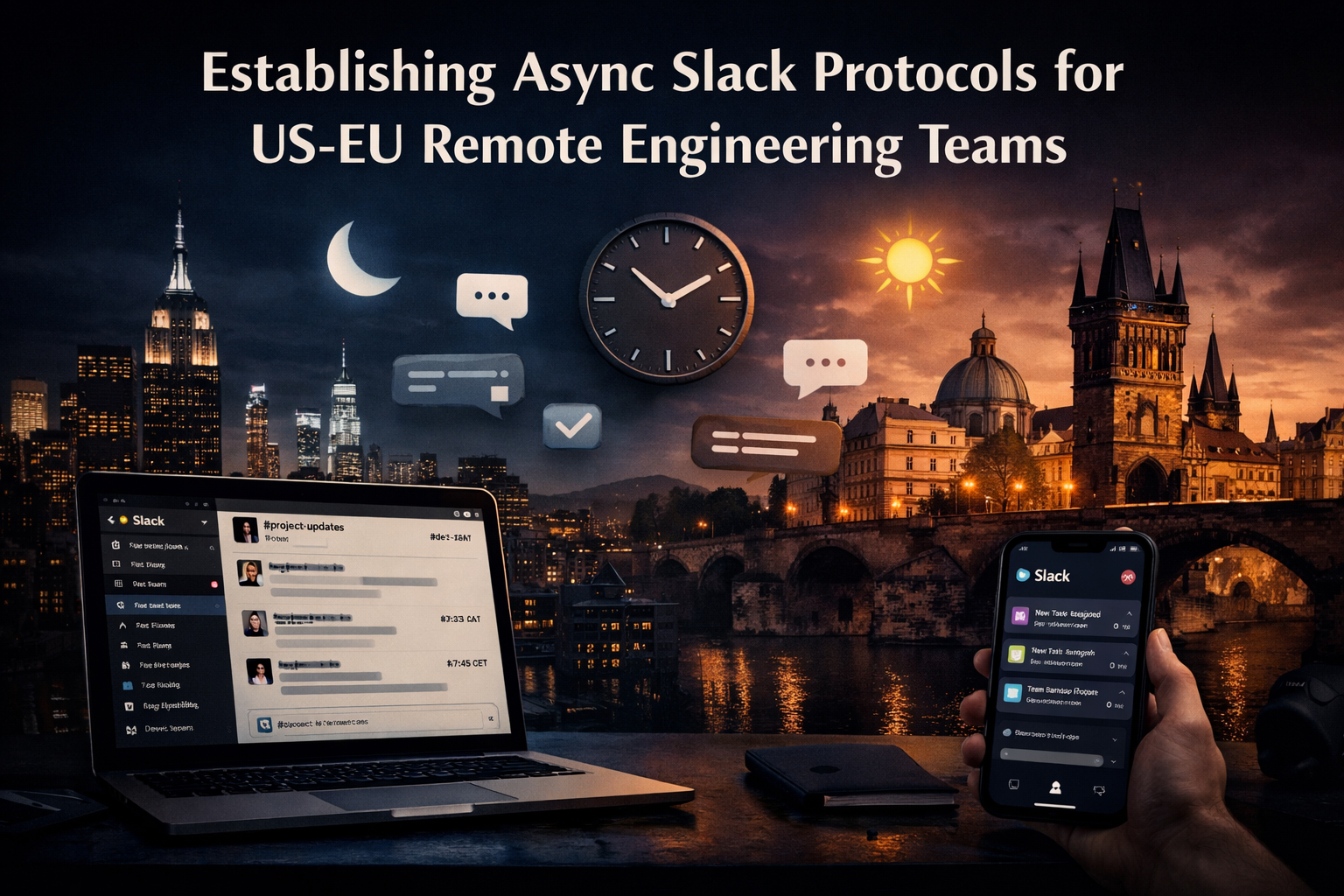

The 3 AM Slack notification is the silent killer of engineering productivity. For US-EU remote engineering teams, the overlap between New York and London is manageable, but San Francisco and Berlin is a logistical nightmare. Without clear boundaries, engineers end up working fragmented hours, destroying their ability to enter a state of deep work.
Establishing async Slack protocols is not just about etiquette; it is a structural necessity for maintaining code quality and team sanity. This guide outlines the specific rules and channel architectures required to make distributed development sustainable.
Why Async Communication Matters for Distributed Engineering
Synchronous communication requires immediate attention, while asynchronous communication allows for delayed responses. In a US-EU remote engineering context, relying on sync communication creates bottlenecks. If a developer in Dublin waits for approval from a manager in Seattle, progress halts for eight hours.
Adopting an async-first mindset shifts the focus from immediate availability to clear documentation. This reduces context switching, which is the primary enemy of coding flow. When protocols are clear, engineers know exactly when they need to be online and when they can focus entirely on building.
Defining the Core Async Slack Protocols
To succeed, teams must move beyond generic advice like “be respectful.” You need enforceable rules regarding how information flows through your workspace. Below are the four pillars of an effective async strategy.
1. Implement Strict Channel Taxonomy
Chaos often stems from using the wrong channel for the wrong type of message. A standardized taxonomy helps engineers filter noise. We recommend the following structure:
- #eng-urgent: Only for production outages or critical security incidents. Pings here wake people up.
- #eng-general: For announcements and non-urgent updates. No immediate response expected.
- #eng-social: For watercooler talk, memes, and team bonding.
- Project Channels: Temporary channels for specific sprints or features, archived upon completion.
By segregating urgent traffic, you protect the majority of your team from unnecessary interruptions during their local night.
2. The “No-Expectation” Window
Define a specific window where no response is expected. For a team spanning PST and CET, this is roughly 16 hours a day. Explicitly state in your team charter that messages sent outside of the 4-hour overlap window do not require a reply until the recipient’s next working day.
Use Slack’s native features to reinforce this. Encourage engineers to set their status to “Focus Mode” or “In a Different Time Zone” during deep work blocks. This visual cue signals to the US team that the EU engineer is offline, preventing the anxiety of an unread message.
3. Threads Over DMs for Technical Context
Direct Messages (DMs) create information silos. If a solution to a bug is discussed in a DM between two engineers, the rest of the team loses that institutional knowledge. Async Slack protocols should mandate that technical discussions happen in public channels using threads.
Threads keep the main channel clean while preserving the conversation history. If a US engineer wakes up and sees a threaded discussion from the EU shift, they can read the entire context without scrolling through hundreds of unrelated messages. This is crucial for handovers.
4. Documentation First, Chat Second
Chat is ephemeral; documentation is permanent. A common failure mode in remote teams is making architectural decisions in Slack. If a decision requires more than three back-and-forth messages, it belongs in a document (Notion, Confluence, or Google Docs).
The protocol should be simple: Discuss the outline in Slack, write the proposal in a doc, and post the link back to Slack for final async approval. This ensures that when the US team logs on, the decision is already recorded and actionable.
Tools and Settings to Enforce Boundaries
Culture is supported by tooling. Slack offers several features that, when configured correctly, automate respect for time zones.
Scheduled Send
Engineers often work late and feel the urge to message immediately. Train your team to use the “Schedule Send” feature. If a London engineer finishes a task at 6 PM GMT, they should schedule the update to arrive in the US channel at 9 AM EST. This prevents the recipient from feeling pressured to reply immediately upon waking up.
Notification Do Not Disturb
Encourage aggressive use of Do Not Disturb (DND) settings. A default DND schedule should be set based on the user’s local timezone. For example, DND from 7 PM to 9 AM local time. This ensures that even if someone forgets to mute their phone, the system protects their sleep.
Handling the Overlap Window
While async work is the goal, the 3-4 hour overlap between the US and EU is valuable. This time should be reserved for high-bandwidth activities that require sync interaction, such as:
- Complex architectural planning.
- Pair programming sessions.
- Team retrospectives and all-hands meetings.
Do not waste this precious overlap on status updates that could have been written asynchronously. Treat the overlap as a sprint planning session, not a status meeting.
Conclusion
Building a healthy culture for US-EU remote engineering teams requires more than good intentions; it requires rigid, well-communicated protocols. By implementing strict channel taxonomies, respecting the “no-expectation” window, and prioritizing documentation over chat, you can bridge the Atlantic without burning out your developers.
Start by auditing your current Slack usage today. Identify which channels are causing the most noise and implement the taxonomy outlined above. Your team’s code quality and mental health will thank you.